Don't Get Played: The Head-to-Toe Authentication Bible for Every Yeezy 350 Generation

Photo: sneaker authentication close up detail inspection Adidas Yeezy, via static.vecteezy.com
Here's the uncomfortable truth: the fake Yeezy 350 market is operating at a level that would have seemed impossible ten years ago. High-quality counterfeits — sometimes called "super fakes" or "UA" (unauthorized authentic) pairs within certain communities — are sophisticated enough to fool casual buyers and even some experienced collectors at first glance.
But here's what the counterfeiters don't want you to know: no matter how good the fake, there are always tells. You just need to know where to look. This guide breaks down the authentication process for every major Yeezy 350 generation, from the OG V1s to the most recent V2 releases. Bookmark this page. You're going to want it.
Start With the Box: Your First Line of Defense
Before you even touch the shoe, the box is doing a lot of talking. Authentic Yeezy 350 boxes share several consistent traits that fakes frequently get wrong.
Label accuracy: The box label on a genuine pair will include the style code, colorway name, size, and barcode in a very specific font and layout. The text should be crisp and clean — no blurring, no ink bleeding, no slightly-off font weights. Compare the style code on the box label against the style code on the shoe's insole tag. They must match exactly.
Box color and material: Authentic Yeezy boxes have a specific shade of orange-brown cardboard with a consistent texture. Counterfeit boxes often come in subtly different shades — either too orange or too tan — and the cardboard itself may feel lighter or flimsier than the real thing.
Lid fit: This sounds minor, but the lid on a genuine Yeezy box fits snugly without being difficult to remove. Fake boxes frequently have lids that are either too loose (rattling slightly) or weirdly stiff.
The Adidas sticker: Some authentic pairs include an Adidas sticker on the box end. If present, it should be cleanly applied, not crooked or bubbling.
V1 Authentication: The OG Checklist
The original Yeezy 350 V1 (2015–2016) has been faked since almost the day it launched, which means counterfeiters have had years to refine their craft. Here's what to zero in on:
Primeknit weave pattern: The V1's Primeknit upper has a very specific woven texture. On authentic pairs, the pattern flows consistently across the entire upper without any bunching, misalignment, or inconsistent density. Fakes almost always show some irregularity in the weave, particularly around the toe box and heel areas where the knitting transitions are most complex.
The heel tab: On authentic V1s, the heel tab is firmly attached and sits flush against the heel counter. The stitching around the tab base is tight and even. Counterfeit pairs frequently have tabs that are either slightly loose, stitched unevenly, or sit at a slightly wrong angle.
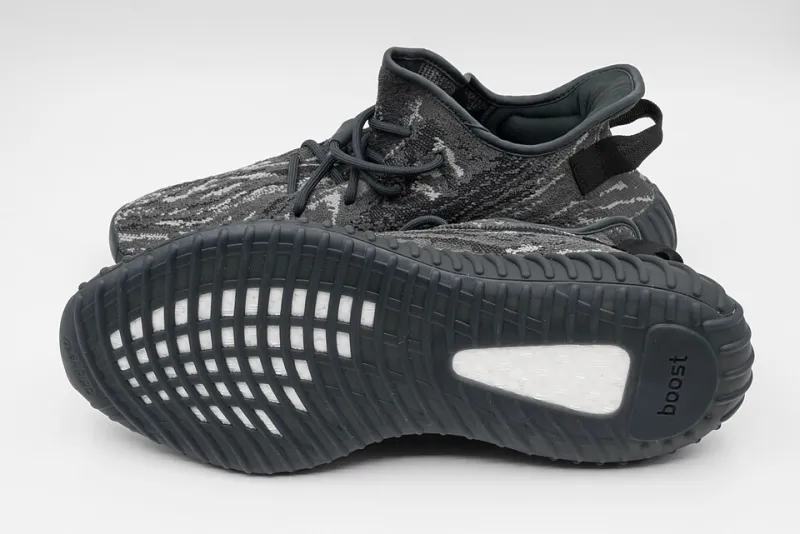
Boost sole texture: The Boost midsole on a genuine V1 has a specific pellet texture — each Boost bead is clearly defined but not sharply angular. Fake Boost often looks either too uniform (like it was molded as a single unit) or too rough and granular. Run your finger across the Boost: authentic pairs have a slightly springy, almost soft resistance. Fake Boost tends to feel harder and more plastic-like.
Outsole pattern: Flip the shoe over and examine the outsole closely. The traction pattern on authentic V1s is precise and consistent. Look at the spacing between the traction elements — on fakes, this spacing is often inconsistent or the elements themselves are slightly mis-shaped.
V2 Authentication: Where the Details Get Trickier
The Yeezy 350 V2 introduced new design elements — most notably the side stripe and the translucent midsole stripe — that gave counterfeiters new opportunities to mess things up.
The side stripe: On authentic V2s, the "SPLY-350" side stripe (or the plain stripe on non-SPLY colorways like Static) is integrated into the Primeknit upper in a very specific way. The lettering on SPLY pairs is bold but not overly thick, and the spacing between characters is consistent. Fake stripes frequently have lettering that's either too thin, too thick, or unevenly spaced.
Translucent midsole stripe: This is one of the most commonly botched elements on V2 fakes. On authentic pairs, the translucent stripe along the midsole has a consistent, slightly amber-tinted clarity. The edges where the stripe meets the white midsole material are clean and precise. Counterfeit pairs often show blurring at these edges, inconsistent translucency, or a stripe that's either too clear or too opaque.
Sock liner details: Pull out the insole and look at the sock liner. Authentic V2 sock liners have a specific feel — a medium-density foam with a slightly textured top surface. The Adidas branding on the sock liner should be cleanly embossed or printed, not blurry or raised unevenly. Fake sock liners often feel either too thin and papery or oddly thick and spongy.
Stitching at the toe cap: The V2 toe box features some of the most complex Primeknit construction on the shoe. On authentic pairs, the stitching here is immaculate — tight, consistent, with no loose threads or uneven tension. This is one area where even high-quality fakes tend to show their hand under close inspection.
Size Tag and Insole Tag Verification
Every authentic Yeezy 350 — V1 or V2 — has a size tag sewn into the interior of the shoe near the collar. This tag should feel firmly attached, not loose or slightly detached at any corner. The text on the tag should include the style code, the size in US/UK/EU/FR/JP measurements, and country of manufacture (authentic pairs are manufactured in China).
The font on authentic tags is a specific weight and style — not quite bold, not quite regular. Fake tags frequently use a slightly different font weight or spacing that, once you've seen it on a real pair, becomes very easy to spot.
The insole tag (printed on the bottom of the removable insole) should also match the box label style code exactly. Any discrepancy between these two is an immediate red flag.
Using Technology and Community Resources
Beyond physical inspection, US buyers have access to some genuinely useful tools. StockX and GOAT both offer their own authentication processes, which is one reason buying through these platforms carries a premium — you're paying for verification peace of mind.
For peer authentication, the r/Sneakers and r/Yeezys communities on Reddit have dedicated authentication threads where experienced collectors will examine photos and weigh in. The Legit Check App is another solid resource that provides AI-assisted authentication with the option to escalate to human experts.
If you're buying locally — through Facebook Marketplace, Craigslist, or local sneaker groups — always insist on meeting in a well-lit location and bring this guide with you. Never rush an authentication check. A seller who's pushing you to decide quickly is a seller worth walking away from.
The bottom line: Fakes are getting better, but authentic pairs still win on the details. Slow down, check everything, and trust your instincts. If something feels off, it probably is.